"Twenty-One Twenty-One" Technical Discussion
- Vanissa Law
- Feb 27, 2023
- 12 min read
Updated: Apr 3
The following is a reproduction of the discussions that occurred during a meeting that was held remotely on 23 November 2022 during the presentation period of Twenty-One Twenty-One, an exhibition under The Missing Link project. Twenty-One Twenty-One is an imagination of Hong Kong in 2121 by Architect Wyan Yeung, which comprised two approximately 150-ft2 rooms at the Police Married Quarters (PMQ) site. This building is located on Hollywood Road in Hong Kong and was rated as a Grade 3 Historic Building in 2010 by The Hong Kong Antiquities and Monuments Office. The Secretary of Development then revitalised the building and turned it into a landmark of design and creativity.
The following discussions were translated from the original Cantonese into English and edited for clarity. The participants were Allan Au (Co-founder, FabLab Tokwawan), Anne Yeung (Founder & Director, One Chain Agency), GayBird, (Co-curator, the Missing Link), Vanissa Law, (Co-curator, the Missing Link), Wyan Yeung (Artist and chief designer of Twenty-One Twenty-One), and Yan Lam (Project Manager, the Missing Link).
About the work
Vanissa: Wyan, could you please share with us briefly the concept of the work?
Wyan: I imagine, in a hundred years, some people continue their lives on Mars, while some others remain on planet Earth. They spent their whole life contributing to their 100-ft2 apartments, and this suffocating living environment forces these residents to transform their outward desires for fancy living spaces to inward admiration for the flow of inner thought and bodily sensations.
Twenty-one Twenty-one occupies two exhibition spaces. Stepping into the room on the left-hand side, the spectator becomes an audience from the year 2121––hence the title of the work––looking back to Hong Kong’s historic nano-building in 2022. All items in this historic architecture are made of iron, which had deteriorated over time. The room on the right-hand side leads to a totally different living space in 2121. The emergence of the metaverse in 2022 has encouraged human beings to pursue inwards to the body and soul. By that time there is no longer clear distinction between the real and the unreal world.
Figure 1. The paralle universes imagined by artist Wyan Yeung occipies two exhibition spaces: the galvanised iron room (left), and the meditation candles room (right)
The rusting process of galvanised iron
Vanissa: The galvanised iron is rusted to give the apartment a stale feeling. How is that achieved?
Wyan: The exhibits were made with new galvanised iron, which is iron covered with a thin layer of zinc.
I chose this material because it was widely used in Hong Kong in the 1950–70s due to its reasonable cost and light weight. It can be easily found in old buildings, especially in Chinese buildings (Tong Lau). Although increasingly rare, you can still see mailboxes and water buckets that are made of galvanised iron nowadays.
For galvanised iron, the zinc on the surface serves as a barrier to prevent the iron from rusting. Apart from protecting it as a physical barrier, zinc also protects the iron by sacrificial protection. Since zinc is more reactive than iron, zinc will react more readily than iron does. Another popular way to prevent metal corrosion is to coat it with paint; the paint acts as a physical barrier to block contact between the metal and oxygen.
Rusting usually happens when the piece of metal is exposed to air for a long time due to the combined action of oxygen (O2) and water (H2O) present in moist air:
4Fe (s) + 3O2 (g) + 2xH2O →2Fe2O3•xH2O (s)
Rust is the name given hydrated iron (III) oxide [Fe2O3•xH2O], which is a soft reddish-brown layer formed on the surface. This oxidation process can be sped up by applying less-active metals, stresses on the iron, or the presence of rust itself. The most efficient way is to apply sulphuric acids on the surface:
Fe (s) + H2SO4 (l) → FeSO4 (s) + H2 (g)
Iron reacts with dilute sulphuric acid to liberate hydrogen gas and form ferrous (iron) sulphate. Ferrous sulphate has a moderate health hazard. Upon contact, ferrous sulphate might irritate the skin and eyes. Inhaling can irritate the nose, throat and lungs, causing coughing, wheezing or shortness of breath. In order to minimise the health hazard, the rusting process was done five days before the exhibition opening, and good ventilation was ensured during the process. Workers wore goggles and gloves during the process to avoid skin contact with the sulphuric acid and ferrous sulphate. On the day before the opening, we wiped the surface with a damp cloth to minimise the health hazard to the general public. Warning signs were put up at the entrance of the exhibition space.
Vanissa: Besides the chemical method, is there any other physical way to increase the rate of rusting?
Wyan: It was not intentional, but when the metal sheets were welded into shapes, the galvanisation was damaged, which lead to some degree of rusting. In other cases, the rusting caused by welding would be unfavourable, but for this project, it is exactly what we wanted.
Figure 2. Before and after sulphuric acid is applied.
Comparing galvanised iron and aluminium
Vanissa: Yes, I am aware that galvanised iron has been very popular in interior design in Hong Kong since the 1950s. Another material that was used, probably a decade or two later, was aluminium alloys, which are still commonly used now. How does it compare to galvanised iron?
Wyan: Aluminium alloys are one of the most commonly used metals in Hong Kong around the 1980s. Aluminium is about half the weight of iron. It has an atomic weight of 26.98 g/mol, while that of iron is 55.85 g/mol. Aluminium is more corrosion-resistant compared to galvanised iron because, after anodising, the thin oxide film can only be melted at over a thousand degrees centigrade. During anodising, an aluminium object is put into a tank with a conducting liquid. Then a current with low voltage and high current passes through the tank and the object. Overall, aluminium is more lightweight, durable and strong compared to iron, but it is more expensive. As society prospered, more and more people abandoned iron and switched to aluminium.
The electronic parasites
Vanissa: The second thing that you will see when you walk into the room is probably the electronic parasites that are either blinking or making a sound. Allan, you built those for Wyan. How many of them are there in total?
Allan: Yes. After discussing with Wyan about what he wanted, I started to build prototypes of these electronic creatures. These kinetic creatures react alarmingly to visitors’ movements around them. There are five of them, each consisting of a ATmega326 microcontroller with a 4-channel IRF540 MOSFET module. They react to visitors in different ways when motion is detected by the adjustable IR-proximity sensors. The sound that you hear is made by 12V solenoids hitting the surface of the galvanised iron structure. One of them carries a COB LED light strip, and another one with a rotatory lamp and light bulb.
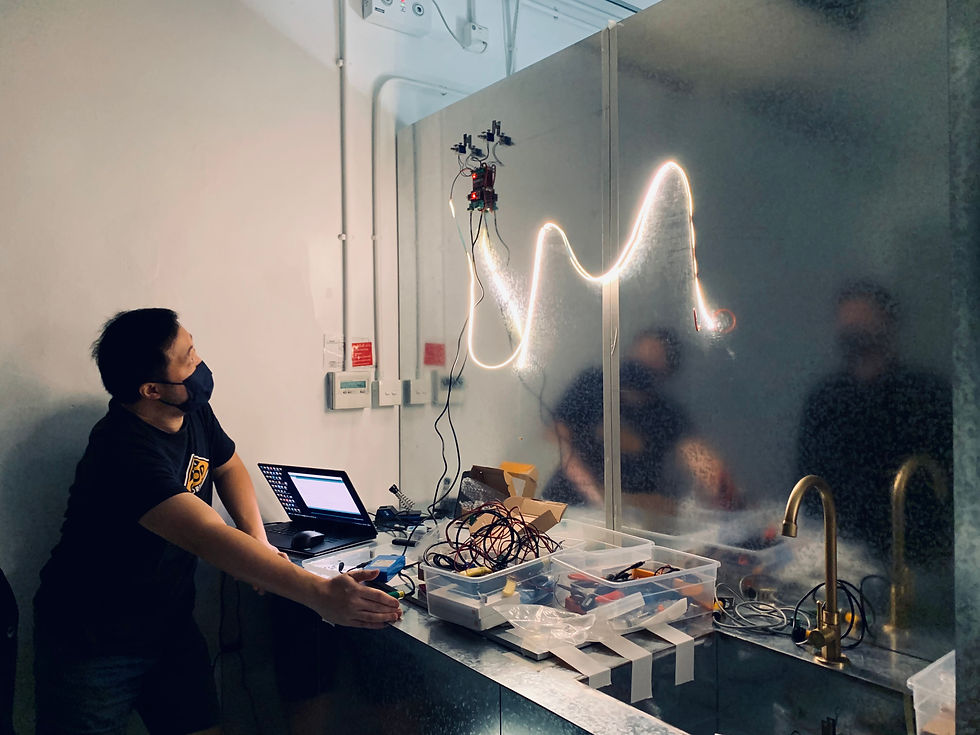
Figure 3. Allan installing and calibrating the electronic parasites.
The program of the interaction is stored in the microcontroller. Reactions to the stimulations of the visitors include programming, such as switching solenoids on and off rapidly at specific time intervals and changing the brightness of the light from a constant value. The parasites are designed to mimic life-like behaviour; therefore, the mapping of the stimulation input and the actuator output is not always linear and constant. For example, on one of the parasites, a triggering counter is set, so that the parasite will only react when a certain amount of stimulation is received. One of them will not immediately calm down after the stimulation has stopped; instead, the brightness of the bulb will be reduced with a constant value over quite a long period of time, to imitate a more organic way that living entities react.

Figure 4. Electronic parasites react to audience's movement in the space.
Soy wax candles
Vanissa: Soy wax candles are used this time, and the melting point is lower than that of common paraffin wax. Is this the reason for the choice?
Wyan: Considering the use in a relatively confined space this time, I decided to use candle lamps to melt the candles instead of actually burning them. I was also worried that common candles have more chemical components, which may release toxic substances when burned. Soy candles made of pure natural materials are relatively safe and reduce the risk of allergies caused by inhalation.
Vanissa: So those are simply safety considerations?
Wyan: Mainly. The other thing is, soy wax will melt more easily than paraffin wax when candle lamps are used.
Vanissa: The candles are not made just of soy wax. There is some other thing inside of it. What is it?
Wyan: Yes, metal wire sculptures were hidden inside of the candles. This combination of soft and hard material symbolises the casting of concrete around a rebar frame in modern buildings. The candles are like miniature skyscrapers in Hong Kong, built by reinforced concrete. The reinforced concrete technique became common at the end of the 19th century in Europe, and it was introduced to Hong Kong in the early 20th century. The first reinforced concrete building was built by the government in 1915. Although the technology is so common that it is difficult to imagine a construction world before it, it only existed for a little more than a century. It became popular in such a short period of time because the cost is lower compared to previous construction with steel frames, iron, stone and bricks. The degradation of reinforced concrete is presented through these soy wax candles with wires inside.
Figure 5. Soy wax candle (left) and the trapped iron wire (right).
But in fact, unlike other historic sites that are built with more durable material such as bricks, reinforced concrete has a limited lifespan. It definitely does not have a permanent warranty. When properly preserved, brick-built structures such as Tai Kwun can maintain their conditions and be retained for 200 years.
Vanissa: I realise the designs and shapes of the metal wire are different in each candle.
Wyan: The candles are hand-moulded; therefore, they are identical in shape but different in pattern and colour. We wanted the insides of the candles to be different, therefore we tried different ways to arrange the wire inside. At the moment we still haven’t found a “best way;” maybe there is no best way. Currently some wires are rolled into a cylinder, and some other are simply laid horizontally.
Although we tried to design the shape of the wire frame, the ways in which the wax are melted are very different. Now we can see in the exhibition that the melted wax spreads into the shape of angel wings, which is definitely not what was predicted on day one.
The interactive limericks
Vanissa: On the wall opposite to the iron bed there is a screen that shows some limericks. Visitors are very fond of them, and some stayed for more than ten minutes trying to see all of them. Can you tell us a bit about that?
Figure 6. AThe interactive limericks displayed on a screen.
Wyan: Yes. Composed by myself, the limericks are actually fun, silly, and somewhat morbid jokes about the absurdity of property prices that turned people in Hong Kong into mortgage slaves. The calligraphy was written by hand and was then digitised and put on a screen in the galvanised iron room. The screen shows only white noise when there is no-one around. When spectators come close to the screen, the sensors that are attached to the bed legs will be triggered, and the video of the limericks’ calligraphy will be shown on screen. Characters appear on screen one-by-one at a reading speed. When no-one is around, the words fade out and the screen returns to video noise.
The calligraphy is also shown in the other room, in a derived form. The digital versions of it are also being displayed in the Twenty-One Twenty-One gallery that exists in the metaverse.
Non-Fungible Tokens and the future of art
Vanissa: The content creators and art industry has gone through a paradigm shift with the introduction of Non-Fungible Tokens (NFTs). Some believe that NFT solves the problem of digital art, which is unlimitedly copiable and then disseminated for an infinite number of times on the internet, and therefore not as unique as physical arts, hence reducing their value. What is so special about this encrypted digital token that people are so crazy about recently?
Anne: One of the very important benefits that NFT brings is the uniqueness of the token. It assures the originality of the artwork directly from the artist. It also benefits artists by allowing them to sell their works directly to buyers, bypassing art market agencies.
Vanissa: It has become a buzzword since the first virtual artwork was sold at record-breaking $69M US in March 2021, and the conversions have been mostly about money. Is it being overvalued?
Anne: The token doesn’t have value in-and-of itself. It is just a representation of a unique digital asset, and the values comes from the asset itself. When someone creates a token that represents the piece of artwork, it’s fulfilled through the process of tokenisation. The token then cannot be swapped or traded for another NFT of the same type. The concept of a Non-Fungible Token is essentially a digital certificate of authenticity that cannot be replicated. The metadata stored in the smart contract of the token ensures uniqueness and, along with the transparency of the history of transactions, allows the NFT to be verifiable by any of the network participants. Therefore, it is absolutely impossible to be counterfeited.
The NFT of the calligraphy artwork is built on Ethereum, where currently most NFTs are sold. Like most of the NFT art, the files are not stored on the blockchain itself. The files were upload to a NFT marketplace called OpenSea, and the link to the uploaded file, along with the token that acts as proof of ownership, are stored on the blockchain.
Architect-as-an-artist
GayBird: How does an identity as an architect affect you as an artist?
Wyan: As an architect we address problems that relate to how people occupy space in their everyday lives. Because the problem of confined living spaces has always been an issue in Hong Kong, it is something that is always at the back of my mind.
Vanissa: I would like to follow up on GayBird’s question about how being an architect affects your creations. For me, because of my music background, music became second nature, and my way of thinking as a musician will be applied consistently to my work even when I am not working on music projects.
Wyan: Conceptually, designing an exhibition is not different from building a house. Both of them require constructions on site, communication within a team of people from different disciplines, and calculation of building materials, etc. Managing and working with people from different professions is one of the very important skills of an architect. Understanding the nature of different professions is a requirement for an architect’s professional assessment. S/he has to make sure everyone completes their job within a timeframe and a budget.
In this exhibition, Anne was responsible for the NFT part, and Allan was responsible for the electronics part. Based on my general understanding of their disciplines, my role is to manage the team and ensure smooth cooperation between the different parties.
To some people, architecture is all about numbers. In fact, there are eight papers in the HKIA professional assessment, including environmental controls, materials and technology, and legal knowledge of all applicable codes and zoning laws. Knowledge of building regulations, fire regulations, and barrier-free concepts are helpful to the designing of an exhibition. I think the role of an architect is kind of like a combination of different identities, such as lawyer, engineer, electrician, and plumber.
Transferrable skills
GayBird: How did the technical skills from your architectural practice apply to the making of art?
Wyan: We planned the exhibition during the pandemic, which impeded the preparation processes with unpredictable logistics and a delayed site visit. In the past, the production team usually meets face-to-face and discusses details at the venue. This time we had to meet remotely without the privilege of actually being in the exhibition space. One of the things that helped to keep everyone on track was the use of the Rhinoceros 3D (Rhino) software. It is a software commonly used in the architectural industry in recent years because it is compatible with Building Information Modelling (BIM). BIM is a holistic process of managing information for a built asset. Unlike amateur 3D design software such as SketchUp, BIM provides accurate measurements down to millimetre; therefore, accurate amounts of materials required can be calculated to keep the amount of pollution and waste to a minimum, and results in less implementation on the spot.
Although I was not designing for a whole building for this exhibition, I conceived and built the 3D models of the two rooms using BIM software. The models were exported to Rhino to generate 2D technical drawings for the contractor to follow.
GayBird: Apart from measurements, did Rhino help with the other aspects, such as the lighting and colour scheme, in the exhibition this time?
Wyan: The data regarding materials, textures, colours, and lighting sources can all be found in the BIM model in Rhino. By extension, during the peak period of the epidemic, it was difficult to meet and hold meetings. Rhino can ensure more accurate communication between artist and contractor, and it can ensure that information and data can be transmitted 100% error-free.
Appendix
About The Missing Link
Curated by composers GayBird and Vanissa Law, The Missing Link consists of three Arts Tech exhibitions, an immersive performance, and a series of open lectures on the current issues in the use of technology in arts. By adding two essential elements—timeliness and performance— into art forms that do not originally exist in time, the two composers wish to inspire new creations and to give more perspective to existing art forms. Through the creation of multimedia artworks the artists explore ways to use technology to connect different types of media to facilitate storytelling.
The Missing Link is a two-year project funded by the Arts Capacity Development Funding Scheme (ACDFS) from 2021-2023. On top of commissioning new art works, the technical goal of this project is to develop a media synchronisation system, which will then become open source to benefit the future development of the Arts Tech industry.
About Twenty-One Twenty-One
Twenty-One Twenty-One was held at the PMQ, Hong Kong, from 11 November to 8 December 2022. It is an imagination of Hong Kong in 2121 by Architect Wyan Yeung. As nano flats has become a norm, terminologies like "coffin terrace,” “black toilet,” and "black kitchen,” have become oral histories among the elderlies. Nano flats thus became part of the torrent of history, and was displayed in the form of a museum exhibit in the Twenty-one Twenty-one exhibition.
Wyan imagined that in 2121 some inhabitants continue their lives on Mars, while some others remains on planet Earth. They spent their whole life contributing to their 100-ft2 apartments, and this suffocating living environment forces the residents to transform their outwards desire for fancy living spaces, to inward admiration of the flow of inner thought and bodily sensations.


Comments